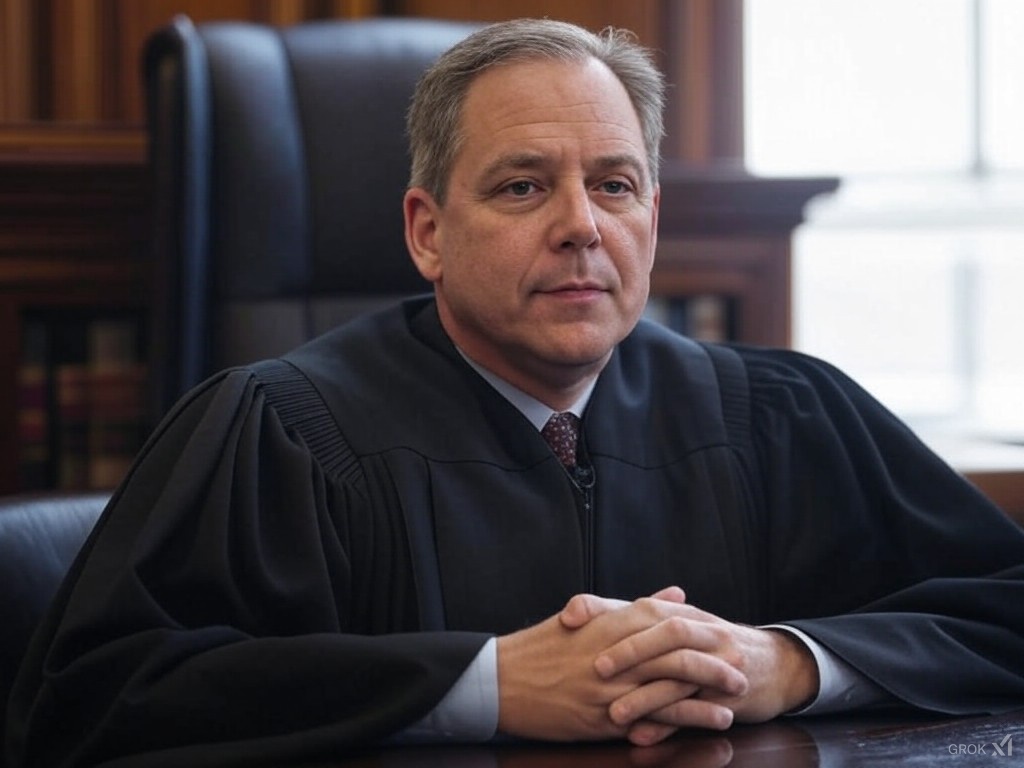
Federal Judge Blocks President Trump's Executive Order to End Birthright Citizenship


In a significant legal development, U.S. District Judge John C. Coughenour has temporarily blocked President Donald Trump's executive order aimed at ending birthright citizenship. The order, signed on January 20, 2025, sought to deny automatic citizenship to children born on U.S. soil to non-citizen parents. Judge Coughenour labeled the order as "blatantly unconstitutional," referencing the 14th Amendment, which guarantees citizenship to all individuals born or naturalized in the United States. ([BBC](https://www.bbc.com/news/articles/c3605g34jx5o?utm_source=chatgpt.com))

The executive order was scheduled to take effect in February 2025. However, it faced immediate legal challenges from eighteen states, including Washington, Oregon, Illinois, and Arizona, which filed lawsuits arguing that the order violated constitutional rights. ([BBC](https://www.bbc.com/news/articles/c7vdnlmgyndo?utm_source=chatgpt.com))

Judge Coughenour's temporary restraining order halts the enforcement of the executive action for at least 14 days, providing time for further legal examination. This period allows the court to consider the substantial constitutional questions raised by the plaintiffs.

The 14th Amendment's Citizenship Clause has long been interpreted to confer citizenship to nearly all individuals born on U.S. soil, regardless of their parents' nationality or immigration status. Legal experts have consistently maintained that altering this interpretation would require a constitutional amendment, not an executive order.

This legal battle underscores the ongoing national debate over immigration policy and the scope of executive authority. As the case progresses, it is anticipated that it may advance to higher courts, potentially reaching the Supreme Court, given its profound implications for constitutional law and civil rights.

The temporary block on the executive order maintains the status quo, ensuring that children born in the United States continue to receive automatic citizenship, as has been the practice for over a century. The administration's response to this judicial decision remains to be seen, as the nation closely watches the unfolding legal proceedings.

- [BBC](https://www.bbc.com/news/articles/c3605g34jx5o?utm_source=chatgpt.com)
- [BBC](https://www.bbc.com/news/articles/c7vdnlmgyndo?utm_source=chatgpt.com)
- [BBC](https://www.bbc.com/news/live/cn0y51z7wedt?page=2&utm_source=chatgpt.com)


Comments

Popular posts from this blog

The Rust Shooting Incident: Misconceptions and Facts

The wrongful confinement of Alec Baldwin for three years in relation to the "Rust" shooting incident starkly illustrates the issues plaguing the U.S. judicial system today. Baldwin's case, which stemmed from an on-set accident resulting in the tragic death of cinematographer Halyna Hutchins, highlighted significant flaws in the legal process. Firstly, the prolonged detention of Baldwin, despite the absence of substantial evidence proving criminal intent, underscores the tendency of the judicial system to prioritize punitive measures over a fair assessment of individual circumstances. Baldwin's role as an actor and producer should have been carefully scrutinized to distinguish between negligence and criminal liability. However, his extended confinement suggests a rush to judgment and a failure to uphold the presumption of innocence. Secondly, this case reveals systemic inefficiencies and bureaucratic delays within the court system. A three-year detention period before ...

Ukraine’s Soldiers at the Front: Battling in the Deadliest Conflict Zones

As the war in Ukraine continues to rage, certain front lines have become synonymous with extreme danger and unrelenting violence. The soldiers on these battlefields face some of the fiercest fighting in the entire war, making their stations among the most dangerous places to be in Ukraine’s ongoing defense against Russian forces. One of these deadly front lines lies in the Donetsk and Luhansk regions, part of the broader Donbas, a war-torn zone that has been at the epicenter of conflict since 2014. This area remains a strategic focus for both sides, as Russian-backed separatists seek to solidify their territorial claims, and Ukrainian forces fight for control over key cities and towns that would provide them with a vital military and logistical advantage. The Hellscape of Bakhmut: A Case Study Perhaps no city better exemplifies the sheer brutality of the war than Bakhmut, a town that has seen constant battle for months. Once home to a vibrant community, Bakhmut now lies in ruins. The o...

Mortimer: The story of Walt Disney’s Mortimer’s flop and success

In the early 1960s, Walt Disney was at the peak of his success. His animation studio had produced some of the most beloved and iconic characters in history, including Mickey Mouse, Donald Duck, and Goofy. But as the years went by, Disney began to feel that his studio had grown stagnant. He wanted to create something new, something that would challenge his animators and captivate audiences in a way that his previous works had not. That's when Disney stumbled upon a character that would change the course of his studio's history. His name was Mortimer, and he was a mischievous little boy with a shock of curly brown hair and a devilish grin. Disney was immediately taken with Mortimer's potential, and he knew that he had found something special. But there was a problem. Mortimer was not the kind of character that Disney's audience was used to seeing. He was too wild, too unpredictable. Disney's wife, Lillian, was particularly opposed to Mortimer, and she urged her hu...